TRIAL RESULTS

NUCALA reduced exacerbations* with data up to 2 years1

NUCALA HELPED PREVENT EXACERBATIONS* IN A PATIENT POPULATION WITH A WIDE SPECTRUM OF COPD AND AN EOS PHENOTYPE1

21% significant reduction in overall moderate or severe exacerbations per year with NUCALA vs placebo

MATINEE: NUCALA + SOC, 0.80/year (n=403), vs placebo + SOC, 1.01/year (n=401) at Weeks 52-104 (RR: 0.79; P=0.01),§ primary endpoint.1

METREX: 18% reduction of moderate or severe exacerbations* at Week 52 for NUCALA + SOC, 1.40/year (n=233) vs placebo + SOC, 1.71/year (n=229). RR: 0.82 (P=0.04),§ primary endpoint.2

*Moderate exacerbations defined as exacerbations (worsening of COPD symptoms) requiring treatment with systemic corticosteroids and/or antibiotics. Severe exacerbations defined as those requiring hospitalization (≥24 hours) or resulting in death.3

In patients (receiving NUCALA or placebo) with analyzable data for assessment at baseline: For the overall population in MATINEE and the efficacy population in METREX, airflow obstruction severity (GOLD grade) by FEV1 % predicted (GOLD 2 [≥50–<80%], GOLD 3 [≥30–<50%], GOLD 4 [<30%]), mMRC dyspnea score|| (Grade <2, Grade ≥2), and chronic bronchitis symptoms assessed by SGRQ-C (presence and absence).1-4 For the efficacy population in METREX, BEC (≥150 cells/µL at screening or ≥300 cells/µL in past year), and smoking status (current, former, never).2,3

SOC=triple inhaled therapy (ICS + LABA + LAMA).
§Mean rate of exacerbations in previous year: MATINEE 2.3; METREX 2.5.1,2
||The mMRC dyspnea scale ranges from grade 0 to 4, with higher grades indicating more severe dyspnea.4,5

MATINEE/METREX study designskeyboard_arrow_right

THE ONLY BIOLOGIC STUDIED FOR 2 YEARS TO HELP REDUCE HOSPITAL VISITS* DUE TO EXACERBATIONS1

35% reduction in exacerbations requiring hospitalization and/or ED visit per year with NUCALA vs placebo

MATINEE: NUCALA + SOC, 0.13/year (n=403) vs placebo + SOC, 0.20/year (n=401) at Weeks 52-104; RR: 0.65 (95% CI: 0.43, 0.96).

Secondary endpoint; not statistically significant due to failure earlier in the testing hierarchy.


*Hospitalizations/ED visits of any length.
SOC=triple inhaled therapy (ICS + LABA + LAMA).

MATINEE/METREX study designskeyboard_arrow_right

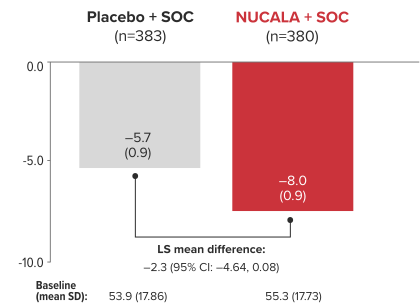
Change in quality of life, based on SGRQ total score*

SGRQ CHANGE FROM BASELINE AT WEEK 52 IN MATINEE1,3

MATINEE: 50% of patients had a clinically important difference in SGRQ on NUCALA vs 46% on placebo at Week 52

Results are descriptive.

Results are descriptive.

MATINEE: 50% of patients had a clinically important difference in SGRQ* on NUCALA (n=390) vs 46% on placebo (n=393) at Week 52. OR: 1.17 (95% CI: 0.87, 1.57).1,3

METREX: 42% of patients had a clinically important difference in SGRQ* on NUCALA (n=228) vs 40% on placebo (n=223) at Week 52. OR: 1.08 (95% CI: 0.74, 1.59).2

All results are descriptive.

SGRQ MEASURES6,7:

Respiratory symptoms

Activity disruption

Psychosocial impact

*SGRQ scores calculated from SGRQ-COPD questionnaire: scores range from 0-100 points; higher scores indicate worse health status. A clinically important difference is defined as a reduction in score of ≥4 points.1,7

MATINEE/METREX study designs keyboard_arrow_right

BEC=blood eosinophil count; CI=confidence interval; ED=emergency department; EOS=eosinophilic; FEV1=forced expiratory volume in 1 second; GOLD=Global Initiative for Chronic Obstructive Lung Disease; ICS=inhaled corticosteroid; LABA=long-acting beta2-agonist; LAMA=long-acting muscarinic antagonist; LS=least squares; mMRC=modified Medical Research Council; OR=odds ratio; RR=rate ratio; SC=subcutaneous; SD=standard deviation; SGRQ=St. George’s Respiratory Questionnaire; SGRQ-C=St. George’s Respiratory Questionnaire for COPD; SOC=standard of care.

NUCALA has a well-established safety profile based on 3 phase 3 trials

INDICATIONS & IMPORTANT SAFETY INFO

INDICATIONS

IMPORTANT SAFETY INFORMATION

INDICATIONS

NUCALA is indicated for the: 

  • add-on maintenance treatment of adult patients with inadequately controlled chronic obstructive pulmonary disease (COPD) and an eosinophilic phenotype. NUCALA is not indicated for the relief of acute bronchospasm.
  • add-on maintenance treatment of adult and pediatric patients aged 6 years and older with severe asthma and with an eosinophilic phenotype. NUCALA is not indicated for the relief of acute bronchospasm or status asthmaticus.
  • add-on maintenance treatment of chronic rhinosinusitis with nasal polyps (CRSwNP) in adult patients aged 18 years and older with inadequate response to nasal corticosteroids.
  • treatment of adult patients with eosinophilic granulomatosis with polyangiitis (EGPA).
  • treatment of adult and pediatric patients aged 12 years and older with hypereosinophilic syndrome (HES) for greater than or equal to 6 months without an identifiable non-hematologic secondary cause. 

IMPORTANT SAFETY INFORMATION

CONTRAINDICATIONS

Known hypersensitivity to mepolizumab or excipients.


WARNINGS AND PRECAUTIONS

Hypersensitivity Reactions

Hypersensitivity reactions (eg, anaphylaxis, angioedema, bronchospasm, hypotension, urticaria, rash) have occurred with NUCALA. These reactions generally occur within hours of administration but can have a delayed onset (ie, days). Discontinue if a hypersensitivity reaction occurs.


Acute Symptoms of Asthma or COPD or Acute Deteriorating Disease

NUCALA should not be used to treat acute symptoms or acute exacerbations of asthma or COPD, or acute bronchospasm.


Opportunistic Infections: Herpes Zoster

Herpes zoster infections have occurred in patients receiving NUCALA. Consider vaccination if medically appropriate.


Reduction of Corticosteroid Dosage

Do not discontinue systemic or inhaled corticosteroids abruptly upon initiation of therapy with NUCALA. Decreases in corticosteroid doses, if appropriate, should be gradual and under the direct supervision of a physician. Reduction in corticosteroid dose may be associated with systemic withdrawal symptoms and/or unmask conditions previously suppressed by systemic corticosteroid therapy.


Parasitic (Helminth) Infection

Treat patients with pre-existing helminth infections before initiating therapy with NUCALA. If patients become infected while receiving NUCALA and do not respond to anti-helminth treatment, discontinue NUCALA until infection resolves.


ADVERSE REACTIONS

Most common adverse reactions (≥5%):

  • Severe asthma trials: headache, injection site reaction, back pain, fatigue
  • CRSwNP trial: oropharyngeal pain, arthralgia
  • COPD trials: back pain, diarrhea, cough
  • EGPA and HES trials (300 mg of NUCALA): most common adverse reactions were similar to severe asthma

Systemic reactions, including hypersensitivity, occurred in clinical trials in patients receiving NUCALA. Manifestations included rash, pruritus, headache, myalgia, flushing, urticaria, erythema, fatigue, hypertension, warm sensation in trunk and neck, cold extremities, dyspnea, stridor, angioedema, and multifocal skin reaction. A majority of systemic reactions were experienced the day of dosing.


USE IN SPECIFIC POPULATIONS

The data on pregnancy exposures are insufficient to inform on drug-associated risk. Monoclonal antibodies, such as mepolizumab, are transported across the placenta in a linear fashion as the pregnancy progresses; therefore, potential effects on a fetus are likely to be greater during the second and third trimesters.


Please see full Prescribing Information and Patient Information for NUCALA.

PMUS-MPLWCNT250056 June 2025

To report SUSPECTED ADVERSE REACTIONS, contact GSK at gsk.public.reportum.com or 1-888-825-5249 or
FDA at 1-800-FDA-1088 or www.fda.gov/medwatch.

References

  1. Sciurba FC, Criner GJ, Christenson SA, et al. Mepolizumab to prevent exacerbations in COPD with an eosinophilic phenotype. N Engl J Med. 2025;392:1710-1720.

  2. Pavord ID, Chanez P, Criner GJ, et al. Mepolizumab for eosinophilic chronic obstructive pulmonary disease. N Engl J Med. 2017;377(17):1613-1629.

  3. Data on file, GSK.

  4. Global Initiative for Chronic Obstructive Lung Disease (GOLD). Global strategy for the diagnosis, management, and prevention of chronic obstructive pulmonary disease. 2025 report. https://goldcopd.org/2025-gold-report/. Accessed March 6, 2025.

  5. Mahler DA, Wells CK. Evaluation of clinical methods for rating dyspnea. Chest. 1988;93(3):580-586.

  6. Jones PW, Quirk FH, Baveystock CM, Littlejohns P. A self-complete measure of health status for chronic airflow limitation. Am Rev Respir Dis. 1992;145(6):1321-1327.

  7. Meguro M, Barley EA, Spencer S, Jones PW. Development and validation of an improved, COPD-specific version of the St. George Respiratory Questionnaire. Chest. 2007;132(2):456-463.