



TARGET EOSINOPHILS IN SEVERE ASTHMA WITH ANTI-IL-5 THERAPY

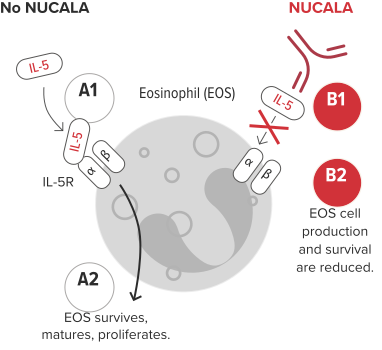
How NUCALA targets eosinophils

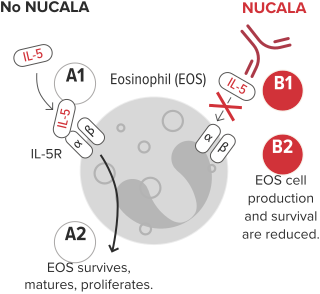
Diagram showing how NUCALA (mepolizumab) targets eosinophils Diagram showing how NUCALA (mepolizumab) targets eosinophils

The MOA of NUCALA in asthma has not been definitively established.

    View the NUCALA MOA

    Mechanism of action | 2:14

    Watch this illustration of the mechanism of action (MOA) of NUCALA (mepolizumab) in asthma.

    What role do blood eosinophils play?

    Eosinophils play a role in maintaining health, which includes regulating the immune system, regenerating and repairing tissue, and host protection (eg, defending the body against parasitic infection).1 In severe asthma, however, too many eosinophils are a key driver of asthma pathophysiology, including airway inflammation.2,3

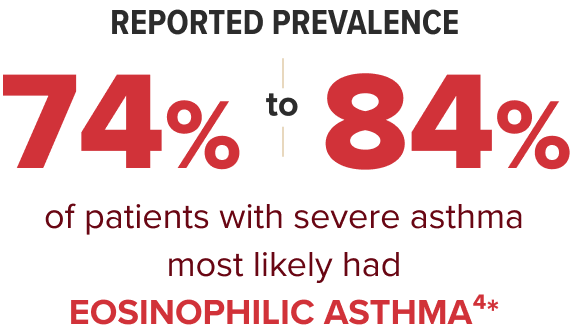
    As shown here, the majority of patients with severe asthma had evidence of an eosinophilic phenotype.4*

    Reported prevalence: 74% to 84% of patients with severe asthma most likely had eosinophilic asthma

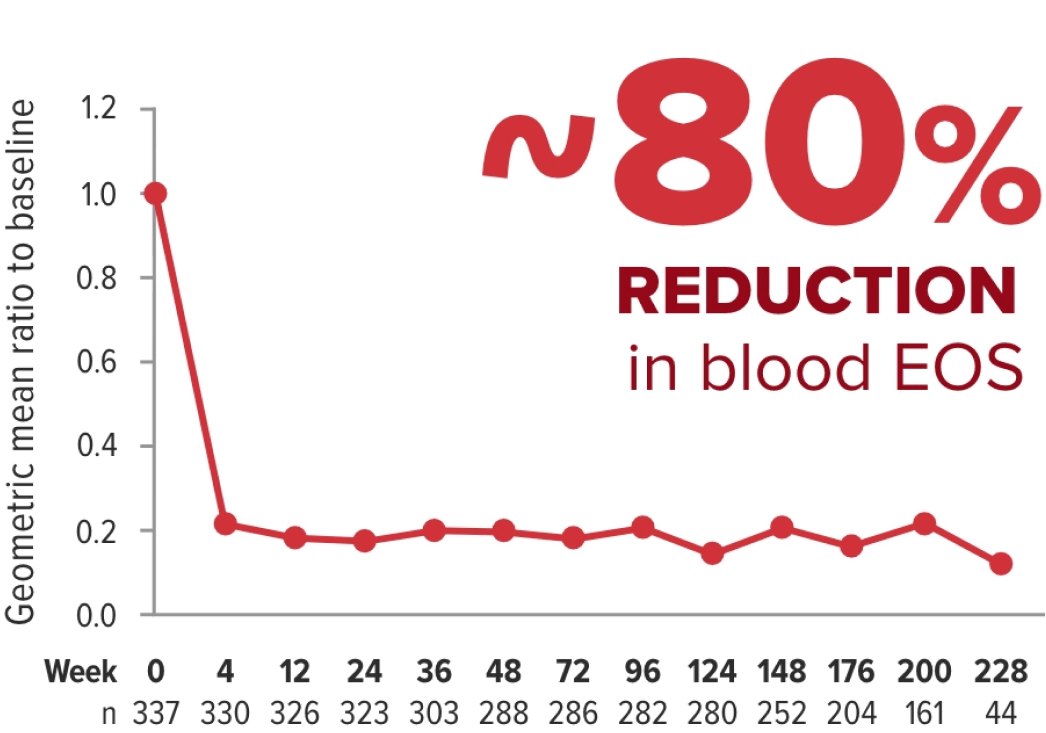
      NUCALA reduced blood EOS levels and maintained them within normal levels

      4.5-YEAR OPEN-LABEL STUDY5,6

      Approximately 80% reduction in blood EOS

      Mean blood EOS levels: 240 cells/μL at baseline; ~40-50 cells/μL on NUCALA treatment.6

      Results are descriptive. The clinical significance of these pharmacodynamic data is unknown.

        In patients with SEVERE ASTHMA, too many airway tissue EOSINOPHILS is associated with9,10:

        • Increased SYMPTOMS
        • Greater likelihood of EXACERBATIONS
        • Airway INFLAMMATION

        EXACERBATION RISK IN PATIENTS WITH SEVERE UNCONTROLLED ASTHMA11*

        • Greater blood eosinophil count was predictive of exacerbation risk
        • Serum IgE level ± atopy was not predictive of exacerbation risk

        *Pooled analysis of 2016 adult and adolescent patients randomized to receive placebo across 7 multicenter, randomized, double-blind, placebo-controlled trials with asthma biologics.11

        Man and woman lying on picnic blanket holding yellow flowers

        CAN YOUR SEA PATIENTS BENEFIT FROM NUCALA?

        Smiling man playing drums with another man playing guitar

        EXPLORE CLINICAL TRIAL DATA IN SEVERE EOSINOPHILIC ASTHMA (SEA) PATIENTS

        DISCOVER OUR WELL-ESTABLISHED SAFETY PROFILE IN SEA

        INDICATIONS & IMPORTANT SAFETY INFO

        INDICATIONS

        IMPORTANT SAFETY INFORMATION

        INDICATIONS

        NUCALA is indicated for the: 

        • add-on maintenance treatment of adult and pediatric patients aged 6 years and older with severe asthma and with an eosinophilic phenotype. NUCALA is not indicated for the relief of acute bronchospasm or status asthmaticus.
        • add-on maintenance treatment of chronic rhinosinusitis with nasal polyps (CRSwNP) in adult patients aged 18 years and older with inadequate response to nasal corticosteroids.
        • add-on maintenance treatment of adult patients with inadequately controlled chronic obstructive pulmonary disease (COPD) and an eosinophilic phenotype. NUCALA is not indicated for the relief of acute bronchospasm.
        • treatment of adult patients with eosinophilic granulomatosis with polyangiitis (EGPA).
        • treatment of adult and pediatric patients aged 12 years and older with hypereosinophilic syndrome (HES) for greater than or equal to 6 months without an identifiable non-hematologic secondary cause. 

        IMPORTANT SAFETY INFORMATION

        CONTRAINDICATIONS

        Known hypersensitivity to mepolizumab or excipients.


        WARNINGS AND PRECAUTIONS

        Hypersensitivity Reactions

        Hypersensitivity reactions (eg, anaphylaxis, angioedema, bronchospasm, hypotension, urticaria, rash) have occurred with NUCALA. These reactions generally occur within hours of administration but can have a delayed onset (ie, days). Discontinue if a hypersensitivity reaction occurs.


        Acute Symptoms of Asthma or COPD or Acute Deteriorating Disease

        NUCALA should not be used to treat acute symptoms or acute exacerbations of asthma or COPD, or acute bronchospasm.


        Opportunistic Infections: Herpes Zoster

        Herpes zoster infections have occurred in patients receiving NUCALA. Consider vaccination if medically appropriate.


        Reduction of Corticosteroid Dosage

        Do not discontinue systemic or inhaled corticosteroids abruptly upon initiation of therapy with NUCALA. Decreases in corticosteroid doses, if appropriate, should be gradual and under the direct supervision of a physician. Reduction in corticosteroid dose may be associated with systemic withdrawal symptoms and/or unmask conditions previously suppressed by systemic corticosteroid therapy.


        Parasitic (Helminth) Infection

        Treat patients with pre-existing helminth infections before initiating therapy with NUCALA. If patients become infected while receiving NUCALA and do not respond to anti-helminth treatment, discontinue NUCALA until infection resolves.


        ADVERSE REACTIONS

        Most common adverse reactions (≥5%):

        • Severe asthma trials: headache, injection site reaction, back pain, fatigue
        • CRSwNP trial: oropharyngeal pain, arthralgia
        • COPD trials: back pain, diarrhea, cough
        • EGPA and HES trials (300 mg of NUCALA): most common adverse reactions were similar to severe asthma

        Systemic reactions, including hypersensitivity, occurred in clinical trials in patients receiving NUCALA. Manifestations included rash, pruritus, headache, myalgia, flushing, urticaria, erythema, fatigue, hypertension, warm sensation in trunk and neck, cold extremities, dyspnea, stridor, angioedema, and multifocal skin reaction. A majority of systemic reactions were experienced the day of dosing.


        USE IN SPECIFIC POPULATIONS

        The data on pregnancy exposures are insufficient to inform on drug-associated risk. Monoclonal antibodies, such as mepolizumab, are transported across the placenta in a linear fashion as the pregnancy progresses; therefore, potential effects on a fetus are likely to be greater during the second and third trimesters.


        Please see full Prescribing Information and Patient Information for NUCALA.

        PMUS-MPLWCNT240085 May 2025

        To report SUSPECTED ADVERSE REACTIONS, contact GSK at gsk.public.reportum.com or 1-888-825-5249 or
        FDA at 1-800-FDA-1088 or www.fda.gov/medwatch.

        References

        1. Weller PF, Spencer LA. Functions of tissue-resident eosinophils. Nat Rev Immunol. 2017;17(12):746-760.

        2. Varricchi G, Bagnasco D, Borriello F, Heffler E, Canonica GW. Interleukin-5 pathway inhibition in the treatment of eosinophilic respiratory disorders: evidence and unmet needs. Curr Opin Allergy Clin Immunol. 2016;16(2):186-200.

        3. Park YM, Bochner BS. Eosinophil survival and apoptosis in health and disease. Allergy Asthma Immunol Res. 2010;2(2):87-101.

        4. Heaney LG, Perez de Llano L, Al-Ahmad M, et al. Eosinophilic and noneosinophilic asthma: an expert consensus framework to characterize phenotypes in a global real-life severe asthma cohort. Chest. 2021;160(3):814-830.

        5. Khatri S, Moore W, Gibson PG, et al. Assessment of the long-term safety of mepolizumab and durability of clinical response in patients with severe eosinophilic asthma. J Allergy Clin Immunol. 2019;143(5):1742-1751.e7.

        6. Data on file, GSK.

        7. Felarca AB, Lowell FC. The total eosinophil count in a nonatopic population. J Allergy. 1967;40(1):16-20.

        8. Hartl S, Breyer MK, Burghuber OC, et al. Blood eosinophil count in the general population: typical values and potential confounders. Eur Respir J. 2020;55(5):1901874.

        9. Wenzel S. Severe asthma in adults. Am J Respir Crit Care Med. 2005;172(2):149-160.

        10. Malinovschi A, Fonseca JA, Jacinto T, Alving K, Janson C. Exhaled nitric oxide levels and blood eosinophil counts independently associate with wheeze and asthma events in National Health and Nutrition Examination Survey subjects. J Allergy Clin Immunol. 2013;132(4):821-827.e1-5.

        11. Kraft M, Brusselle G, FitzGerald JM, et al. Patient characteristics, biomarkers and exacerbation risk in severe, uncontrolled asthma. Eur Respir J. 2021;58(6):2100413.